Frequently asked questions – Implantable Contact Lens Procedure by Dr Raymond Stein

May 18th, 2012

What is the Implantable Contact Lens (ICL) procedure?
The ICL is a very thin implant that is inserted through a microscopic opening in the cornea and positioned between the iris and the normal crystalline lens. The implant has a central thickness similar to a human hair, which is 50 microns said Dr Raymond Stein

How do I know if I am a good candidate for the ICL procedure?
Patients that are not satisfactory candidates for laser vision correction are usually good candidates for the ICL. This usually means that the prescription is too high, and/or the corneas are too thin or are irregular. Usually whatever vision you have with glasses or soft contact lenses can be achieved postoperatively without optical aids. Patients should have a pupil size measured in dim light of 7 mm or smaller. There must be a satisfactory distance between the back surface of the cornea and the crystalline lens of 3.0 mm or greater. The eyes should be healthy inside without evidence of cataracts or significant macular degeneration.

What tests are performed to be sure that I qualify for the ICL?
A refraction is performed to determine your prescription and your vision. An instrument called the Colvard pupillometer is used to measure the pupil size in dim light. A Pentacam or Orbscan is performed to determine the distance from your cornea to your crystalline lens. An IOL Master is performed to determine the width of your cornea to assist in determining the length of the implant.

Should I discontinue my contact lenses prior to the preoperative testing?
Yes, it is important to stop wearing soft contact lenses for approximately 5 days and rigid gas permeable lenses for at least 3 weeks prior to the preoperative testing. Contact lenses can potentially change the shape of the cornea and it is important that the corneas return to their normal shape prior to the preoperative testing.

Is the ICL customized for my eye?
Yes, the ICL is ordered directly from Switzerland where it is custom made for your eye. The lens has a specific prescription to correct nearsightedness, farsightedness, and/or astigmatism. In addition it is ordered with a specific length so that it fits well inside your eye.

How long does it take to receive the ICL from the time it is ordered?
It takes approximately 6 weeks for the Bochner Eye Institute to receive the ICL from Switzerland after it has been ordered.

Why is a laser iridotomy necessary prior the ICL procedure?
A YAG iridotomy is a simple laser procedure to create a microscopic opening in the iris. This is important prior to the ICL procedure to prevent a buildup of eye pressure. Fluid normally flows inside the eye directly through the pupil. The ICL can potentially block fluid flow and create a high intraocular pressure. A small opening in the iris is created which allows fluid to travel through the iris and prevent a buildup of pressure.

Are both eyes treated the same day?
Usually the eyes are treated on different days, a few days a part. Dr Stein wants to make sure the first eye in perfect before treating the second eye.

How does the ICL procedure differ from a refractive lens exchange?
There is no tissue removed with the ICL. With a refractive lens exchange the crystalline lens is removed using ultrasound and an artificial lens is inserted.

What are the advantages of the ICL over a refractive lens exchange?
By leaving your own crystalline lens in place you will retain your ability to see up close to a similar degree that you had prior to surgery with your glasses or contact lenses. With age the crystalline lens becomes harder and loses its ability to naturally change shape and help with focusing for near objects. This typically occurs between 42 and 46 years of age. By leaving your own crystalline lens in place you will retain your reading ability without glasses. If you are in your mid 40s then reading glasses will be required.

Is there anything I can do to avoid reading glasses?
Monovision can be performed in which one eye is treated to give the best distance vision and the other eye is treated to provide reading vision. Patients will often get used to their vision and function well. Sometimes driving at night may be more difficult and a simple pair of distance glasses can be prescribed so the reading eye is sharp for distance.

How is the ICL procedure performed?
The procedure is performed in the operating room. Your pupil will be dilated with dilating drops. Your eye will be frozen with anesthetic drops. Your lids and surface of the eye will be cleaned with a disinfectant solution. A paper drape will be placed over your body and head. There will be a small opening that exposes your eye. A speculum will be inserted to open your lids. A small incision will be made in the cornea. The ICL, which has been folded, is then inserted through a microscopic corneal incision into your eye. The ICL is then carefully positioned behind your iris and in front of the crystalline lens. Your pupil will then be constricted with drops. An antibiotic medication will then be instilled. You will then sit up and be escorted to the recovery area. After 30 to 45 minutes you will be taken to the first floor where Dr Stein will examine your eye and check your eye pressure. You will then be able to go home to rest. A follow-up appointment will be arranged for the next day.

Can I receive some sedation for the procedure?
Although most patients find the procedure relatively easy, an anesthetist will be present, and if you feel you would like some sedation this can be administered.

How quickly will my vision recover?
There is usually a rapid improvement in vision over 24 hours. Most patients have satisfactory vision for driving by the next day. It may take a few months for final healing to occur.

What are the potential complications of the ICL procedure?
Complications are uncommon with the ICL procedure. There is less than a 1% risk of developing a cataract or clouding of the lens. If this occurs the ICL can be removed, the cataract extracted, and a new implant inserted. The success rate is excellent at restoring vision. There is a theoretical risk of infection but no cases have been seen at the Bochner Eye Institute.

What can be done if I have a small prescription after my ICL procedure?
If you have a small prescription after the ICL then laser vision correction can be performed. Usually we wait a few months to be sure that your prescription is stable and your eye is fully healed.

Dr Raymond Stein learn more

Dr Raymond Stein discusses the “Future of Cataract and Refractive Surgery” at the Vision Institute’s annual meeting in November

November 18th, 2011

Dr Raymond Stein was an invited guest speaker to the Vision Institute’s annual meeting in Toronto on November 4, 2011. The title of his presentation was “The Future of Cataract and Refractive Surgery”. Dr Stein discussed some of the new innovative treatments such as Laser Cataract Surgery, Corneal Inlays for presbyopia, Corneal cross-linking combined with topographic laser ablations, and Microwave technology for keratoconus. The audience was over 300 eye-care professionals.

Dr Raymond Stein discusses Corneal Cross-Linking at the American Academy of Ophthalmology’s annual meeting in October

November 18th, 2011

Dr Raymond Stein was invited to speak at the American Academy of Ophthalmology’s annual meeting in Orlando on October 21, 2011. His session was titled “Ask the Expert” and he spoke on the subject of Corneal Cross-Linking in Keratoconus.

Femtosecond Laser for Creation of LASIK Flap

January 25th, 2011

Dr. Raymond Stein of the Bochner Eye Institute wrote the following clinical update. We hope you find it of interest.

Many reports have demonstrated the superiority of Femtosecond laser created flaps over flaps created with a microkeratome blade: increased flap thickness accuracy,1,2,3 greater consistency of flap thickness,4,5 the elimination of button-hole flaps,1,6 decreased epithelial injury,4, 7 greater flap adhesion strength, 8 faster visual recovery and better uncorrected visual acuity,8,9 improved contrast sensitivity,10 better refractive astigmatic neutrality,5 decreased higher order aberrations,11 and decreased corneal insensitivity and tear function compromises.12,13

The laser flap has a uniform or planar thickness. A blade creates a meniscus flap, which results in a thinner flap in the centre and thicker in the periphery. This can lead to one of the most dreaded LASIK complications of a button-hole, which often results in loss of best-corrected vision from irregular astigmatism or scar tissue. When we acquired a Femtosecond laser, four years ago, our initial plan was to offer both the Femtosecond and blade technologies. However, after doing our first cases we quickly sold our microkeratome. All prospective laser patients should be aware that the Femtosecond laser provides the most technologically advanced and safest procedure.

Why would some laser centres continue to offer inferior technology? The answer is very simple — cost. The purchase of a Femtosecond laser costs around $500,000, there is an annual maintenance fee of around $70,000, and a disposable cost (suction ring) of approximately $200 per eye. A microkeratome can be purchased for $25,000 or less, there are no annual maintenance fees and the cost of a blade is around $50 for both eyes. So you can see from a cost point of view there are significant savings for a laser centre to offer inferior technology using a microkeratome.

Femtosecond technology continues to advance. At the Bochner Eye Institute we acquired the first IFS laser in Canada, which has a speed of 150 KHz. This is 2.5 times faster than the previous laser technology. This results in the suction ring being on the eye for less time, thereby providing a more comfortable experience for the patient. In addition, the new technology can create a flap edge greater than 100 degrees. This leads to a more stable flap position like a man-hole cover, and a lower incidence of epithelial ingrowth.

At the Bochner Eye Institute, Raymond Stein, MD, and his team continue to treat a significant number of eye-care professionals from across Canada and the United States. We feel this is because eye doctors understand leading-edge technology and trust our surgical techniques and abilities. To learn more, please contact Bochner Eye and Dr. Raymond Stein today.

  1. Binder PS. Flap dimensions created with the Intralase FS Laser. J Cataract Refract Surg. 2004;30:26-32.
  2. Javaloy J, Vidal MT, Abdelrahman AM, Artola A, Alio JL. Confocal microscopy comparison of Intralase femtosecond laser and Moria M2 microkeratome in LASIK. J Cataract Refract Surg. 2007; 23:178-187.
  3. Patel SV, Maguire LJ, McLaren W, Hodge DO, Bourne WM. Femtosecond laser versus mechanical microkeratome for LASIK: a randomized controlled study. Am J Ophthalmol. 2007;114:1482-1490.
  4. Kezirian GM, Stonecipher KG. Comparison of the Intralase femtosecond laser and mechanical keratomes for laser in situ keratomileusis. J Cataract Refract Surg. 2004;30:804-811.
  5. Talamo JH, Meltzer J, Gardner J. Reproducibility of flap thickness with Intralase FS and Moria LSK-1 and M2 microkeratomes. J Cataract Refract Surg. 2006;22:556-561.
  6. Binder PS. One thousand consecutive IntraLase laser in situ keratomileusis flaps. J Cataract Refract Surg. 2006;32:962-969.
  7. Duffey RJ. Thin flap laser in situ keratomileusis: flap dimensions with the Moria LSK-One manual microkeratome using the 100-micron head. J Cataract Refract Surg. 2005;31:1159-1162.
  8. Knorz MC, Vossmerbaeumer U. Comparison of flap adhesion strength using the Amadeus microkeratome and the IntraLase IFS femtosecond laser in rabbits. J Refract Surg. 2008;24:875-878.
  9. Durrie DS, Kezirian GM. Femtosecond laser versus mechanical keratome flaps in wavefront-guided laser in situ keratomileusis: a prospective contralateral eye study. J Cataract Refract Surg. 2005;31:120-126.
  10. Tanna M, Schallhorn SC, Hettinger KA. Femtosecond laser versus mechanical microkeratome: a retrospective comparison of visual outcomes at 3 months. J Refract Surg. 2009;25:S668-S671.
  11. Montes-Mico R, Rodriguez-Galietero A, Alio JL. Femtosecond laser versus mechanical keratome LASIK for myopia. Ophthalmology. 2007;114:62-68.
  12. Tran DB, Sarayba MA, Bor Z, Garufis G, et al. Randomized prospective clinical study comparing induced aberrations with IntraLase and Hansatome flap creation in fellow eyes. J Cataract Refract Surg. 2005;31:97-105.
  13. Lim T, Yang S, Kim MJ, Tchah H. Comparison of the IntraLase femtosecond laser and mechanical microkeratome for laser in situ keratomileusis. Am J Ophthalmol. 2006;141:833-839.
  14. Barequet IS, Hirsh A, Levinger S. Effect of thin femtosecond LASIK flaps on corneal sensitivity and tear function. J Refract Surg. 2008;24:897-902.

Dr Raymond Stein, Toronto the most experienced surgeon with Corneal Collagen Cross-Linking in North America

November 8th, 2010

Raymond Stein MD presented his  outcomes of Corneal Cross-linking at the American Academy of Ophthalmology (AAO) in Chicago on Oct 19, 2010.

The AAO is the largest ophthalmological meeting in the world with an attendance of over 20,000.

Dr Raymond Stein in Toronto is considered one of the most experienced with Corneal Collagen Cross-Linking in North America having treated over 1,500 eyes with keratoconus.

Read more about Dr Raymond Stein and what his patients are saying.

Laser vision correction: 20 years of personal experience by Raymond Stein

October 20th, 2010

“Laser vision correction has been an exciting and innovative area of clinical practice. I feel fortunate to have been involved in Excimer laser treatments over the past 20 years. I have used Excimer lasers that were the size of a small bus. I performed treatments that took as long as a full song by the Beatles. I saw patients in the early laser days who if they had to rate their post-op pain on a scale of 1-10 with 10 being the highest, they rated it an 11. Despite this level of discomfort, they all came back for their second eye.”  from EyeWorld

Raymond Stein learn more

Raymond Stein MD- As featured in ASCRS EyeWorld Publication

Raymond Stein

Raymond Stein featured in Post City Magazines

September 8th, 2010

“If you had Canada’s top eye surgeon, Dr. Raymond Stein, cornered for 10 minutes, what would you ask him?”

Click here to Read More:

Post City Magazines- Raymond Stein MD

Raymond Stein’s patients share their positive thoughts

August 18th, 2010

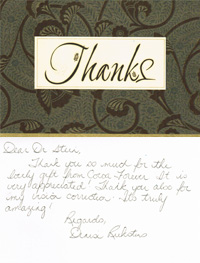
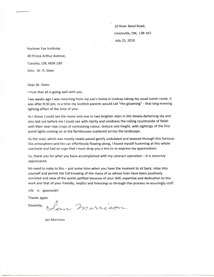
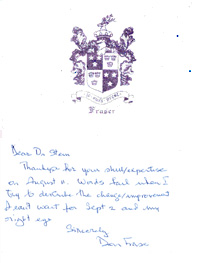
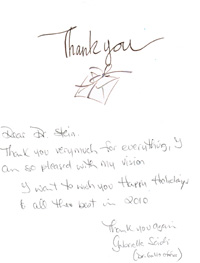
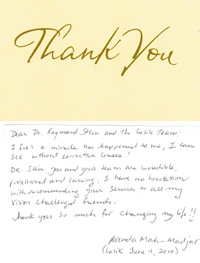
Click on the Thumbnails to view the inside of Raymond Stein’s Thank you Cards!

Thank you very much Ray Stein!

Please Click on thumbnail to view the inside of the Card

surgeons_ray_testimonials_17

Click on the image to view the patient testimonial

What Raymond Stein’s Patients are saying?

August 18th, 2010

Raymond Stein MD Toronto- Patient Thank you Cards

Thank You Raymond Stein

Raymond Stein MD- Patient's express their Thank You's!

Learn more about Raymond Stein Toronto

Raymond Stein- More Patient’s share their positive experiences!

August 18th, 2010